I invite you to listen to this rich conversation that I enjoyed with my son, Jacob.
Sign up for my free monthly newsletter & receive Jacob’s prayer requests during his missionary journey.

Interested in supporting my writing ministry?
The strongest memory is weaker than the palest ink. I write to remember.
I invite you to listen to this rich conversation that I enjoyed with my son, Jacob.
Sign up for my free monthly newsletter & receive Jacob’s prayer requests during his missionary journey.
Interested in supporting my writing ministry?

It is early, and the air is frigid as I push back our heavy comforter, shivering as I slip from bed. I pluck my warmest socks from our bottom left drawer, memory serving me well in the dark.
I have awakened with the words swirling fast and furious, so I text remembrances to myself, as I brush my teeth minty, squinting at the brightness of bulbs.
Soon I am dressed–a soft, threadbare hoodie and sweatpants, beloved and tattered and dotted with speckles that pay tribute to the colors of our home–Village Square, Owl Gray, Honest Blue, Butternut. I descend the cold hardwood stairs and whisper good morning to our trio of pets who blink at me and stretch; yawning.
We travel as a pack outside, and the bright ball of yellow moon, a beauty which hung low and heavy and mournful in the pitch of sky only days ago, has now melted and waned and whitened, perched high and faint; a fading crescent.
I miss the robust harvest moon in the way I miss our children: wishing for swaths of time together that once seemed full and endless. My heart tiptoes around loss, as I grow familiar with separation, phantom pains of amputation slowly morphing toward contentment, hard-won.
The stars blink and twinkle, steady and hushed, and I am small against the inky backdrop; fragile as I regard the constellations. Three nights ago I reveled in the canopy of dark as a shooting star lept and danced and dropped earthward. I stand undone, pondering the greatness of God, who with mere thought and command, flung these wonders to dot the sky.
Our dogs give me a nudge, noses cold on my hand, and I scratch their heads while Josephine Bean, Joey, meows, rubbing her head against my shins. My breath puffs cold as my hand circles the doorknob. Longing to stay in this quiet beautiful, I glance up one more time, freeze-framing the wonder of it all, such ancient loveliness no painter can match.
Inside, I measure and pour three bowls of dry pet food and finally reach for coffee grounds. I notice Joey limping, and I hazily recall her previous tussle with a neighbor’s cat.
With animals tended and coffee brewing, I waltz into the canopy of Monday’s headspace, aglow with delicious possibility.
Mondays are my favorite. A peaceful, solitary stretch to write and write and write some more. It is the only day in which I am not expected to appear anywhere. It is life-giving, and I shield Writing Mondays like a guard at Buckingham Palace, protecting his Sovereign.
Yes, Mondays are for slipping away, carrying only thoughts and keyboard. A few minutes of slow stretching gives way to a long morning walk as the sun lifts in the eastern sky, pastel portraits of oranges and pale pinks. These walks are cushioned by prayer, podcasts, and the sizzle of song. Thoughts emerge that could break any writer wide open, but the Author of memories and words keeps me.
Life is one long story, I decide as I walk. Days stacked upon days, and the trajectory is like a shooting star careening toward eternity. The truths within our stories will become either a duck and run or a pressing in, a steadfast journey of perseverance.
As I walk I carve and slice with the sharpest of blades, wielding my knife invisible, abandoning unnecessary words on the chopping block. Everything promising ends up in a thick notebook, material that might not see the light of day for years.
A family of deer lurches ten paces before me, gracefully emerging from the woods, across the path, and over the golf course where they pause and stare. They are handsome, a broad-chested male with thick antlers, his gentle, wide-eyed mate, and their four offspring sporting wet and shiny noses. A hawk soars overhead and the deer leap and prance from the meadow into the nearby thicket.
The sky has now begun to awaken, and I slip off my headphones in favor of birdsong.
Two squirrels chase up the old maple and down again, racing for the larger pine. A chipmunk scurries toward the edge of the wood, as a flutter of leaves floats earthward, rocking back and forth in the wind, little boats in no particular hurry, landing peacefully to their death. The burnt reds, yellows, and oranges will soon fade brown, and I think: from dust we came and dust we return.
***
I return home, sip coffee, and lose myself in the pages of 1 Thessalonians before settling in at my desk.
The previous three Writing Mondays have gone quite poorly with interruptions aplenty. I thus grew dull of thought, sluggish, and overwhelmed by initial streams of thought mercilessly crushed by too many social engagements paired with the whiplash of trials unfolding beyond the walls of our home.
It is time for the tide to change, and my soul swells as the words flow on this Monday morning. I am praying for the richness of today’s work to match the magnificent harvest moon: satiating and delicious; a feast.
The table is now graciously set to write, and I aim to honor my goal of completing two pieces while beginning a third. My heart is cartwheeling, as I think: our girl is coming home, our girl is coming home, our girl is coming home. I have missed our daughter something fierce this semester, and am longing for the holiday break. This spurs my excitement at the prospect of getting ahead in my work.
How I am pining for our morning coffee rituals and unhurried conversations in our pajamas. Time spent swinging wide the hutch doors and digging around for our cookie cutters, mixing and rolling and smoothing the sugar dough like we do come November and December. And our beloved movies–we will watch them all, oh yes, we will.
I am writing away when I receive a phone call that I cannot ignore. There is another issue to tend to, and one hour later all concentration has begun to wilt and perish. I wander into the kitchen in defeat, heating the kettle for oolong, mentally fighting to return to the ashy embers and beg a flame, when Joey limps through the kitchen on three paws.
My eyes widen–her back leg has swelled to ghastly proportions. I watch in horror as she presses herself thin, flattening and escaping beneath our sofa.
It is then I realize that she has retreated to die.
Frantic, I whisk her to the vet– sans makeup, in my paint-splattered sweats with thick socks and worn-out Crocs that I slip on to save time. My hair is yanked through my favorite ballcap–all of this my normal attire for my beloved (and typically invisible) Writing Mondays.
Except today I am not hidden.
It is not until I blow into the emergency clinic that I consider my appearance.
There are swarms of people in the waiting area, and I am now deeply worried about Joey, who is our college daughter’s beloved pet. Wildly embarrassed by my appearance, I attempt to quietly speak above the din to the receptionist, with the cat carrier perched countertop. Did I mention that my husband and I could not figure out how to properly attach the door? And that electrical tape now holds the steel piece in place?
This? The stuff of nightmares, I tell you.
Name? The receptionist snaps her gum, manicured fingers clicking the keyboard as she types.
Kristin.
She looks at the crate. And what is wrong with Miss Kristin?
No, I am Kristin.
She sighs. What is the cat’s name, Ma’am?
Joey.
Joanie? What is wrong with Joanie?
I lean closer, inwardly perishing as people stare.
No. Joey. Josephine Bean.
Cute. She laughs too loudly and blows a snapping bubble.
Why, I am thinking, did I not pause before I left the house and swish mascara on my lashes, or spritz perfume on my wrists, or at least lace up my good sneakers?
But I know the answer. Our smidgen of a cat was suffering and I was racing against the clock.
After ten minutes, they whisk our lethargic, swelling feline to the back and I slip into a seat in the back row, praise be, hiding while mentally refiguring my workweek as the hourglass sands drizzle.
I think back to this morning, now a lifetime ago: the waning moon, the stars, the chill of autumn, the deer, and the brilliant sky that glowed as the dark awakened to light. My warmed heart now feels squashed, my plans squelched, roadkill for the fourth Monday in a row.
Suddenly, a high-pitched screech erupts, and a woman anxiously teases her sweatshirt drawstring as her cat wails. The animal slinks dull and feverish in its carry case, at death’s door, poor thing, and the round, middle-aged woman is brushing her tears away. Her husband wraps his thick arm around her shoulder, and in that moment they become their own universe.
It is oddly lovely, as full and true as the harvest moon.
It’s okay darlin’ he comforts, and I hear his smoker’s voice, uninhibited. The entire, overfilled waiting room must also hear it as we are stuffed together in this sad space.
As I observe this couple it is not too hard to imagine them sharing an ashtray at their Formica kitchen table. Smoke swirls as they trade newspaper comics, munching Sarah Lee coffee cake straight from the tin, a dull kitchen knife smeared with frosting as they slice ample pieces, washing down the pastries with endless cups of tepid Maxwell House.
We’ll do whatever it takes because we love her, right darlin’? he comforts, pulling her close. Neither husband nor wife would be considered even remotely attractive by the world’s harsh measuring stick, but I think: Who cares? This is living. This is lovely.
He shuffles her even closer, his movements rough, but not unkind, smooching the top of her head.
But the money? she whispers looking up at his face in grief and in trust.
It is undeniable: he is her sun, and she is orbiting.
Husband waves a hand over his protruding belly. It don’t matter, darlin’. And he smiles. I’ll work it out.
The vet assistant appears, taking the sick creature back for examination. The large husband wraps his bride in his arms as she weeps, and I turn away at such beauty.
***
I have been watching this movie unfold, and it seems that so has the middle-aged lady seated in front of me, next to her own husband. She tucks her salon-cut hair behind her ear and I see a sparkling diamond, a crown jewel. Her starched collar is upturned, crisp; timeless. Her man is dressed to the nines, cologne swirling expensive, his elbows resting on his knees as he works the phone with two hands.
Their pet must already be in the back because the only thing between them now is space. And plenty of it.
After a moment she turns: Do you think Everett will be okay? she whispers.
He shrugs. He better be, for what we are about to pay.
She glares, fingers toying her diamond.
But I love him, Peter.
Don’t I know it! He rolls his eyes and his phone pulses and he stands. I’ll take this outside.
And he is gone.
Her profile is one of high breeding, classy, but seasoned with sadness. Her doe eyes fill as she studies the couple two rows over. The pudgy couple who have no diamonds to sparkle.
The longing on this woman’s face haunts me–and I turn away at such sorrow.
***
In my haste to save Joey, I forgot to bring paper and pen, so I tap my terribly neglected notes app and string words together as I consider the stealth of pain, the brokenness swirling around me, the brokenness within me, and what this means in the light of eternity as we sweep through impossibly jagged shards.
I remember the moon. While the luminescent sphere in the night sky waxes and wanes, this satellite itself is unchanging. Our frail perspective, our dim eyes, and our feeble earthly positions fool us into believing otherwise.
How much more so, God? Unchanging, steadfast, and perfect. Master of all.
He is Lord over sweet marriages with Hey darlin, and difficult marriages with painful spaces. He is to be trusted when the children are small and the dinner table is full and loud and filled with laughter. He is to be trusted when the table is small and the presence of absence is weighty.
God is unchanging in our bouts of sickness and mounting bills and in flashes of soaring health and stuffed bank accounts. He is the Author of every Writing Monday that crumbles and perishes, and the Author of every Harvest Monday that sparkles as the words light up the page.
He is my Treasure, my Hope, my All.
And through it all, I–mere dust and bone– am made to fall before him in worship and in trust. He knows what he is doing, and that is my peace.
God is Lord of the faint, waning moon and Lord of the magnificent, buttery harvest sphere.
A sight that makes any poet ache and burn.
***
After an hour, the vet called me back to say that Joey got into a scrape with either a copperhead or another cat. Her fever soared as the infection raged. They flushed her tiny frame with antibiotics and armed me with pain meds for days. She will recover.
My girl is coming home, my girl is coming home, and you are alive, I warble the entire way home, to Miss Josephine Bean.
***
Last week I could almost reach out and touch the harvest moon, but then it paled, fading dim.
God is near.
The LORD reigns; he is robed in majesty; the LORD is robed; he has put on strength as his belt. Yes, the world is established; it shall never be moved. Your throne is established from of old; you are from everlasting.
Psalm 93:1-2
This week’s piece is from my archives.
Are you seeking to write for the glory of God? Please consider signing up for Write the Truth, Beautifully.™
Dear Youth Minister,
My husband is also my pastor. Most Sundays, after he preaches, we walk to the back to greet people, and I whisper: great message. Then we turn to converse with the congregation.
What I really mean by great message is this:
Join me over at Rooted Ministry to keep reading.
I remember a few childhood afternoons spent roller-skating straight through Raquelle’s lobster-red kitchen, her Italian mother enormously great with child, baby number nine. This sainted woman cradled the phone, laughing as we dipped beneath the mustard cord and sailed beneath her tattered oven mitts, hands that cradled an enormous tray of bubbling lasagna. When we grew tired of lapping their downstairs, we unlaced our skates, padded in our stockinged feet to the laundry room, and ripped open a chocolate cake mix packet for Raquelle’s Easy-Bake oven.
Soon, an army of little brothers clustered round, licking the spoons and swiping the frosting from the bottom of the store-bought cylinder. I marveled at the rising decibels of noise, the utter chaos, and the love fluttering inside their home.
***
Playdates at Andrea’s house were notably different, as her mother preferred painting to domestic duties. Dirty dishes were stacked precariously high in the sink, drinking glasses smeared and foggy, countertops sticky. A Mount Everest-sized laundry pile soared beneath the basement’s laundry chute.
Andrea’s mother chewed her bottom lip, eyebrows rumpled as she toyed with the paisley bandana cinched at the base of her long, pale neck. She was surrounded by clusters of stout jars filled with murky water atop a water-stained dining table that butted up against her broad easel.
When Andrea asked her mother for a snack, she was met with a glare from the short-tempered artist, her words clipped and exasperated. The vibe to seven-year-old me was obvious: children, laundry, cooking, and housework were burdensome distractions. Everything played second fiddle to her creative pleasures.
Given this gloomy internal state of affairs, Andrea and I tumbled outdoors singing The Sun Will Come Out Tomorrow at the top of our lungs, pretending we were little Orphan Annie.
The family’s enormous Saint Bernard, Maggy, stood watch, guarding us with mournful eyes.
***
Jeanie, another childhood chum, was a surprise daughter born to old parents. The pair of us squandered afternoons playing chopsticks, fooling around on the baby grand, learning scales, sitting ramrod straight as we swung our legs and clanked away in the immaculate living room. A living room with plush, ivory carpet.
Jeanie grew tired of chopsticks long before I, as did her mother, who shooed the two of us upstairs, while anxiously fingering her strand of pearls: Play something quietly, girls, while I fix a snack.
Soon, the aroma of blueberry muffins filled their home. Muffins, which I knew from prior experience, would be dry as a bone. Jeannie’s mother, soft-spoken and well-bred, was clearly tired, hurrying us to finish, sweeping up our crumbs with a sigh while we were still chewing.
We gulped our apple juice, zipped up our snowsuits, and sped outdoors, grabbing two wooden sleds along the way. As we sailed down the steep back hill, we spoke dreamily of cocoa and marshmallows to ward off winter’s chill. But then I remembered the luxurious carpet, and my delight dimmed.
We would get in trouble for spilling our cocoa.
***
My grandmother was a fine cook. Oh my, I can still taste her melt-in-your-mouth roast with pearl onions and long slices of tender carrot, surrounded by clusters of soft, tiny potatoes. Once Grandpa bowed and offered grace, Grandma disappeared into the narrow kitchen, teasing liquid into gravy. I wandered in once, and only once, mind you, curious. I slipped beside her as she whisked, her tongue pressed between her lips, stirring with gusto.
I must have temporarily forgotten that while cooking was her strong suit, patience was not.
It’s hot, she said. Go sit down.
I crept back into the dining room, as everyone talked loudly over and around each other, scooping potatoes and spearing slices of roast, passing the heavy salt and pepper shakers, slicing and buttering the rolls. Grandma returned, smiling thin, the porcelain gravy boat clutched in her bent, arthritic fingers. Steam puffed delicately from the dish, a fact I noted while blinking back tears.
I longed to explain that I did not mean to get in the way, but instead, I stayed quiet, irritated and confused as I placed the cloth napkin across my lap, forming a perfect rectangle. Across the table, my cousin stared, amused, no doubt, by my threatening tears. He stuck out his tongue and fluttered his hands by his ears. I rolled my eyes and wrinkled my nose.
Life carried on.
***
Recently, with the advent of fall, I decided it was high time to redeem the roast. Beef enveloped by seasoned julienned carrots, alongside new potatoes. Throwing caution to the wind, I upped my game and tinkered around with spices, which proved rewarding. Dare I say better than Grandma’s roast? If not, at least equal. Savory, tender, melt-in-your-mouth forkfuls of delight.
When my pastor-husband and I return from church in the late afternoon, spent, we are welcomed by the warm aroma seeping from the crockpot. I scratch our dog’s ears, slip off my shoes, and shed my earrings. Pulling two bowls from the top shelf, I dish up dinner as Jon turns on the football game. We sink into our chairs and exhale as Jon says grace.
***
I have plans.
Long-term intentions, tiny seeds planted in my grandmother’s kitchen, in Jeanie’s tidy living room, in Andrea’s loveless kitchen, seeds watered while roller skating through Raquelle’s boisterous home. As a child, I bore witness to dozens of matriarchs, reading them like a chapter book…through the warmth of their eyes, the chill in their gaze, the softness of their embrace, the brusqueness of their hands, their carefree laughter or pursed lips, their abandon in serving others joyfully, or their stubborn determination to do whatever they pleased, serving only themselves.
I was a little girl who noticed, paid attention. A child with magnificent dreams of raising a big family. A child who grew up into womanhood, and who by God’s grace became a wife, a mother, a mother-in-law, and a grandmother.
What trail of memories will I leave for my family and friends?
Will they feel cherished, seen, and known?
***
It grieves me to observe so many women chafe beneath God’s precious design for womanhood. If only they could see the endless delight, responsibility, old-fashioned hard work, and immeasurable joy that come in nurturing a godly family; in stitching beauty and order within whatever four walls the Lord provides.
And the grandest kingdom work of all? Crouching low, in order to gently look your children and grandchildren in their eyes, pausing to unhurriedly listen to their hearts, their fears, and their dreams, while teaching them about God with soft, gracious speech.
Kind words, laughter, delicious food, and a comfortably tidy home are powerful weapons against the prince of darkness.
Warm eyes and soft embraces slice straight through worldly chaos: I want you here, I love you, you are dear to me. Take off your shoes and stay awhile.
***
Here is what I now know: a delicious roast, without love, is nothing.
Bubbling lasagna, easy bake cake, without laughter, kindness, and joy, is nothing.
While a dirty home with piles of dishes and dirty laundry is terribly unwelcoming, so is a clean home run by a grumpy, moody mistress.
Hospitality is a happy-hearted servanthood that begins at home, and it will cost me dearly: time, money, planning, and a million deaths to myself. The dividends, however, prove staggering: monumental, cascading through the generations.
My grandchildren will remember my happy heart, my eagerness to play, and the direct eye contact in patiently answering their questions. I have promised to keep their snack drawer and treat jar full, in order to make them feel known and loved. They will believe that they are cherished through my patience, preparedness, and playfulness. How else will they intuit that they are never a nuisance?
My children will remember my interest and love for them through thoughtful questions, listening, encouragement, unexpected gifts, fine coffee, and their favorite foods.
God wields every single circumstance, even the unpleasant ones, to teach us something true, and it is our responsibility to pay attention. The adults of my childhood remind me, even now, of a shadowed reality: Children and grandchildren are perceptive, with memories stretching long.
When my grandchildren one day ask me what I am cooking, I will pause, pull up a chair, and invite them to step up.
May I remember that the secret lies not so much in the spices, but in the love spilling from my heart.
Better is a dinner of herbs where love is than a fattened ox and hatred with it.
-Proverbs 15:17
Home is the place where hungry hearts are fed on love’s bread.
-James Russell Miller

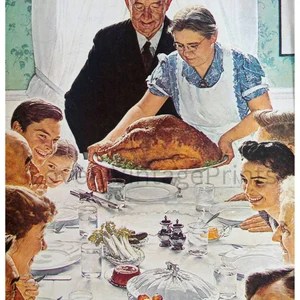
(Top image: Norman Rockwell’s Freedom From Want)
Mothers of missionaries know the tale well. Once upon a time, our children were babies: safely swaddled, a bundle of joy in our arms. Now they are missionaries: globe-trotting, gospel-sharing adults, ever precious to our hearts. How stirring to watch our children forsake earthly comforts to share the hope of Christ. He is their treasure, and for this we prayed…
Please join me over at Desiring God to keep reading When Missionaries Say Goodbye to Mom, an article I was recently humbled to write.
I am delighted to have finally been able to record this conversation with our daughter, Lauren, the mother of our first (and most adorable) granddaughter.
Lauren’s Etsy shop
Sign up for Lauren’s newsletter
My personal favorite: Elisabeth Elliot Print
There is an unexpected tenderness, a sober joy, soft, unshakeable, even as my flesh faints and my bones seem crushed by sorrow. I stand quietly and watch the world burn —set on fire, torched by the prince of darkness.
Christians are assassinated and martyrs continue to perish worldwide, as they have throughout the ages. Men and women steadfast, ramrod straight in their stalwart refusal to renounce their sole passion: Jesus Christ. They are being slaughtered now, a dozen or more each day.1 Great is their heavenly reward.
Amid such brutality, I bring you good news of hope and truth, a curl of smoke ascending from the ashes.
With eyes kind and tone soft:
God is ruling, always working, and always good, no matter what atrocities unfold. The Bible promises that the days will worsen, growing darker as the return of our Savior grows closer.
As part of the remnant—God’s true children in faith—we dwell under the shadow of the Almighty, even as we break and break and break again.
Our suffering and groaning will not last forever. As wickedness prevails, plod on in faith, and do what is right in God’s eyes, even as this world does what is right in their own eyes.
Let us encourage one another to stay faithful to God by treasuring Jesus, obeying the Bible, repenting of sin, and doing good.
Cling to this: God holds Satan on a short leash, and nothing that happens on planet Earth is random.
In the midst of sadness and suffering, it is crucial to remember that God’s will is not capricious, but purposeful.
Waste not a second. Now is the time to make your calling and election sure.
Resist the urge to fool around, scrolling the news all day long, studying conspiracy theories, descending into tunnels of evil. We already know God’s judgment: people love darkness instead of the light.
Crack open your Bible and chase down truth: eternity is coming, and not everyone who says Lord, Lord, will enter the kingdom of heaven.
Dear Bona Fide Christian,
(not doer of good deeds, nor member of a specific political persuasion, nor self-sufficient one, but wretched sinner, saved by God’s mercy and grace)
Remember, according to Jesus Christ, we are the light of the world.
So, when this life erupts, a volatile powder keg of mass evil, may you, may I, burn calmly, brightly, and steadily until the end… lanterns for all the world to see.
And as we grieve, may we be found singing through our afflictions with a flutter of enduring hope beating in our chest, as we dwell upon our beautiful inheritance. Christ died in our stead and will carry us from this present darkness into the arms of God.
***
Last evening, I stepped beneath the stars, feeling small and fragile. Gazing heavenward, I was undone by the endless constellations blinking against the obsidian night, brilliantly defying all darkness.
You are the light of the world. A city set on a hill cannot be hidden. Nor do people light a lamp and put it under a basket, but on a stand, and it gives light to all in the house. In the same way, let your light shine before others, so that they may see your good works and give glory to your Father who is in heaven.
-Matthew 5:14-16

I stood wounded
by rapid-fire words.
Be my shield, God.
My heart is sore.
***
I stood captivated
by a bluebird
pecking in our yard.
The sun dazzled and caressed-
Brilliant feathers, unmatched.
God’s paintbrush,
strokes of splendor,
nature trilling.
***
The bluebird
toted a sprig of grass
tender in its beak.
To the birdhouse he soared,
low,
rising softly,
nest building.
Blade by blade
He labored,
instinctive;
undeterred.
***
So too, go I.
Stringing words,
chiseling sentences,
fashioning a nest of thoughts.
Stories woven,
cradling life.
***
Wounds not wasted.
Scars reborn:
explore, create, write.
A tiny offering to my Creator.
Warmed his jarring mercy,
Kept by his endless grace.


I can imagine you now: sharpening pencils, organizing folders, surrounded by paper, pencils, and erasers. You have packed away bathing suits and beach towels–farewell, summer–as you soar into September, swooning over the possibilities on the cusp of this school year.
Cheered by the thought of beginning again, you smile, your heart singing as you blow a chef’s kiss over the tall stack of textbooks, inhaling this vibrant beginning, as cool and shiny as a penny.
How I remember the swell—no, a roar of invincibility—This year will be the best!
As an older woman who now sees the forest through all those mighty Redwoods, may I encourage you to set aside your beloved curricula and lean in?
While academic studies have their place, grades, achievements, and human accolades are fading shadows.
Successful homeschooling, in God’s eyes, is heart work.
****
I am saddened by the blustery Christmas cards we have received for decades: For unto you is born this day, a Savior who is Christ our Lord, followed by a folded letter, carefully showcasing children’s academic prowess: soaring GPAs, president of this, high achiever of that, and on and on and on it goes.
How confusing to pay lip service to the truth that your child’s worth is bound up in God as an image bearer, and to then pivot and boast about grades, IQs, and awards. What will happen when your student hits a rough patch, loses a scholarship, or grows weary of the pressure to perform, ceasing to make you shine?
For the Lord sees not as man sees: man looks on the outward appearance, but the Lord looks on the heart.
Please, please do not hear what I am not saying. There is nothing wrong with high intelligence, a gift from God, to be stewarded well.
But as my grandparents used to say: Smart is as smart does.
In other words? Learning to walk in humility, godliness, and kindness is far more important than acing trigonometry.
Additionally, I am not suggesting a laissez-faire approach to home education, nixing the Peloponnesian Wars, Algebra II, Latin, or biology. A well-rounded education is valuable, and yes, I held high academic expectations for my children and encourage you to do likewise. It is good and wise to develop minds for the glory of God.
If you only hear one thing today, may it be this: the bulk of faithful homeschooling means first and foremost training and equipping your children for every good work. Over time, I realized my chief aim was to teach my children to love the Lord with all their hearts, souls, and minds. (Matthew 22:36-38) This heart work involved regular tune-ups: modeling diligence, kindness, humility, courtesy, timeliness, servanthood, forgiveness, and respect.
I look in the rearview mirror and see so clearly what mattered. Those schooldays when a poor attitude was corrected and forgiven, the days when a big brother rose to comfort his sister, when siblings cheered each other on in athletics, recitals, and contests. The moments spent teaching my children to read and write. The year we spent memorizing the book of James, words that still return with a flourish to convict my wandering heart. Our family, shoulder to shoulder in the pew, each and every Sunday. The togetherness of those decades, unbreakable family ties, and our love for God that anchored us throughout life’s storms.
We love each other, albeit imperfectly, but we also like each other, a fact I do not take for granted.
What does this have to do with decades spent homeschooling?
Everything.
The greatest gift my husband gave me was trusting me to teach our children as we played the long game: preparing our four favorite people to pursue a life of godly wisdom rather than chasing the stuff of this world. I prayed that they would love God supremely, know and cherish the Bible, and consider others more important than themselves. This trajectory meant pouring into my children’s hearts.
Does this sound like an impossibly tall order, dear homeschooling mom?
In our own strength, it is.
Rather, heap your trust upon God as you endeavor to do your part, praying for the Lord to work in your children’s souls as well as your own. Be faithful as you labor each day. Give your sons and daughters the gift of structure as you model timeliness, showing them that our great God is a God of order.
This homeschooling endeavor is not achieved overnight, but little by little, day by day, month by month, year by year.
We are imperfect, sinful mothers who serve a good, kind, and perfect God.
****
Children flourish beneath a high bar of godly expectations, seasoned with gentleness, understanding, kindness, and grace. (And donuts, on the first and last day of school.)
Seek to know each one of your children’s strengths and weaknesses. Encourage them often, cheer them onward.
May I encourage you to offer up a feast at the beginning of each school day? An unshakeable triumvirate: Bible reading, Scripture memorization, and prayer.
With souls thus softened, jump into the pages of The Pilgrim’s Progress, The Hobbit, Lad: a Dog, Shiloh, and Little Britches. Live your read-alouds to the hilt, with grand expression, laughter, and even tears, transporting your favorite people from the living room, as you together soar to another time and place.
Help them thirst for good books, and The Good Book. Make them long to hear one more chapter.
Now, with souls softened and hearts tended, cheerfully crack open those textbooks and get going: math, spelling, handwriting, grammar, history, and science, keeping in mind that the beloved curriculum cradled in your hands plays second fiddle to godliness, a work of the heart. (Proverbs 4:23)
“Mothers, the godly training of your offspring is your first and most pressing duty.”
Charles Spurgeon
Write the Truth, Beautifully™ is now available for you!
Upstairs, I have an old photograph, in which I am cradling our newborn. We are studying each other, our profiles etched, two upturned noses kept frozen in time, mother and son. My face achingly young, his softly brand new.
I am smiling from the shadows, dressed in my husband’s button-down shirt, the lighting poor, our camera cheap.
That old striped Oxford was my wardrobe extraordinaire in postpartum days, soft, loose. I pined for comfort as motherhood had risen to jolt, ushering in oceanic feelings, all-consuming tides. The fervent motions continued long after labor and delivery, a revolving cycle of nursing, changing, rocking, swaying, soothing, singing, crying. My muscles whimpered tender from hefting seven deliciously-scented pounds of miracle upon my shoulder.
It was 1996 and we lived humbly, with few distractions. No extra money, no internet, no cell phones. Come to think of it, no email. In hindsight, such simplicity proved priceless. My feet and mind were planted on terra firma as I pushed the stroller around our apartment and whispered to my little Caleb descriptions of everything I saw, heard, felt, touched, and tasted.
Puffy white clouds, quacking mallards, gentle breezes, scorching sun, soft blanket, tart lemonade, minty gum, I love you, I love you, I love you.
As I spoke my affection, I also begged him to sleep–the one thing he clearly did not prefer. We circled around the lake, returning home. I gentled him in the wind-up swing, cranking that contraption to a fare-thee-well, clockwise, knowing that I had precisely nineteen minutes until it would slow and stop, waking him again.
If I hurried I could fluff the pillows, spritz the bathroom mirrors, fold the laundry, and rush a steaming shower.
Most days, however, I slid into my rocking chair, gazing proudly at our stunning little bundle of sweetness.
I was now a mother.
****
Motherhood displaced my heart, which now danced and hovered outside my body.
It pulsed hard, following our little man everywhere, our baby who was soon cooing, sitting, teething, crawling, and talking. Mornings, he reached his pudgy arms skyward, calling Mama, as I plucked him from the crib into my arms, pajamas all snug.
Good morning, Bugaboo.
I nuzzled the soft spot on his neck with my nose, before kissing it repeatedly as he giggled, his small fists tangled up in my hair.
My heart, my world.
Less than two years after becoming a mother, I shook my husband’s arm. It was nearly midnight and time to drive to the hospital once again, the pains bearing down, sweeping my breath away.
Between contractions, I worried. How could I ever love another baby as much as our Caleb?
Treason!
Such heavy thoughts brought tears to my eyes.
All fear vanished by lunchtime the following day. I had been proven wonderfully wrong. The moment our second son was born, and my husband held him high, my heart lept, and doubled in size.
I was smitten as I cradled him, inhaling his newborn scent. Counting his fingers and studying his long eyelashes spun me into a sea of bliss. In the years to come, I fell hard in love two more times, with the birth of our third son and then our daughter. The togetherness of us, our familial love and laughter, was more delightful than I ever dreamed.
My heart was an inferno, on fire, and had now quadrupled in size. God had entrusted me with these four beauties, little image bearers with souls that would never die. Motherhood was my ache, my dream, a hard work soaked with gravity and laced in beauty, a serious endeavor to be cradled, gently.
Those early years of motherhood were earthy. Four children to nurture, teach, discipline, and love. Full days of wiping sticky hands and jellied tables, mountains of laundry to smooth and fold, bandaids to apply, fevers to soothe, hugs and kisses, and reams of books to read aloud. It was board games and races and hide-and-seek. Sheer physical exhaustion come nighttime, waking early to do it all over again.
Oh, how I loved the slow, long, steady life of motherhood. Tangible work, gritty and good and meaningful, fingernails caked with dirt, sweat, and love.
****
Winds of change arrived repeatedly, blowing in breezes and occasional tempests. The moment my heart had grown accustomed to the earthiness of my calling, the seasons swelled and changed, leaving me to reach for a windbreaker, rain jacket, hoodie, or heavy winter coat.
One quotidian day I realized our cradles and high chairs and booster seats and diaper bags were gone. My children were growing up with new horizons and friendships and weighty decisions, joyous victories filled with laughter, and sometimes broken hearts and tattered dreams. There were championship games and recitals, driving tests and college applications, goodbyes and graduations, engagements and weddings, moving trucks and missionary journeys.
So many goodbyes over and over and over. Changes that left me breathless.
And then the evening arrived when I set our dining room table pretty for two. Our new normal. My heart tiptoed about and then broke just a little as my husband and I held hands, bowed our heads, and said grace, our forks clinking against our plates, breaking the hush.
It’s hard, isn’t it? he said, his eyes filling.
Later, I washed the dishes as he took out the trash.
My hands scrubbed slowly, and gently as I prayed.
It was a healing balm, easing the ache a little, just me before my God, as I remembered his promises throughout Scripture. He had chosen to make me a mother and as long as I had breath, my work was not finished.
Earth, wind, and fire.
The fire?
Oh, the fire.
It burns steady, strong, and hot. Such unconditional love, my prayers rising. I am a house-on-fire, one average, middle-aged mother, on bended knee.
****
Last week I stood on our back porched and for the better part of an hour watched a squirrel building a nest–a drey it is called–out of leaves and twigs. She crawled to the end of a limb, bit off a sliver of a leafy branch, ran down to the grassy earth, picked it up in her teeth, and raced to the highest of heights, fussing and building, moving twigs and leaves every which way.
Her diligence and patience paid off. I shielded my eyes against the sun and imagined a handful of baby squirrels mewing, tucked safely in the crook of the massive tree, in the nest the mother had labored to build.
They would be warm and safe for a time, but soon Mama Squirrel would release them to the earth, teaching them to hunt and forage and in time, build their own nests.
****
My hands no longer rock the cradle, smooth back sheets, or prepare my children’s meals. (How I miss my sous chefs!) But the joy of motherhood carries on through every conversation, phone call, text, and gathering. Caleb, Jacob, Marcus, and Lauren are priceless gifts.
During the decades I spent raising our children, God was raising me. Motherhood has shaped and refined me, drawing me close to the heart of my Heavenly Father.
Thank you, God, for such undeserved treasures.
Behold, children are a heritage from the LORD, the fruit of the womb a reward.
Psalm 127:3
Write the Truth, Beautifully,™ my audio writing class, will be available September 1. You spoke, and I listened, making this class accessible to each of you at your personal convenience.
 The Palest Ink