I am a country mouse at heart, a fact I attribute to personality paired with a pleasantly primitive childhood.
I grew up on a quiet and quaint New England road–Old Mill Road–pulsing with four deliciously distinct seasons, flush with beauty: stately trees, a broad backyard field, lush gardens, and a peaceful pond.
Majestic maples glowed- every hue on fire as autumn erupted: burnt red, tangerine orange, buttery yellow, against the backdrop of chimney smoke slowly rising, curling upward, its rustic scent invigorating. Winter’s snow arrived with fury, all fluffy for sledding and biting temperatures creating ice, perfect for skating at our pond. It was a small, lovely pond encircled by trees, maples, birches, and pines, a wall of beauty buffering winter’s howl; branches weighted low, hushed by ice, stilled by snow.
Just when it seemed that winter had settled in to stay, spring swept in, all gentleness and grace, her soft breezes smiling, dancing, and melting gray snow into puddles. Puddles which pooled and dried beneath the sun’s warm tilt, as trees yawned and stretched, stirring from a long winter’s nap, their branches popping with verdant buds.
The pond’s ice thinned and thinned and thinned once more, before melting away. Turtles’ heads bobbed, breaking the surface, and fish awakened from hibernation. A chorus of frogs lulled me to sleep, a pretty lullaby as I hugged my stuffed bear and memorized the moon from my bedroom window.
By the time school ended in mid-June, summer reappeared, our season for romping outdoors. My brother and I swung on our tire swing beneath the crooked crabapple tree, toeing the dirt, spinning faster and faster, sweaty and dizzy, touching the tree trunk to steady ourselves, our small hands cascading a knotted trunk peppered with woodpecker holes.
We scooped and shoveled roads for my brother’s trucks in our sandbox, raced in the back fields, and feasted on warm, sunbaked raspberries, decadent blackberries, and tangy Concord grapes—plucked from the side gardens. The pair of us reveled in games of tag, racing between the billowy sheets hung from the clothesline. Blissfully exhausted, we freed our pet rabbits from their hutch, laughing as they hopped and scampered at our feet, noses twitching as they nibbled thistle and field grass.
After lunch, we slipped down the pond’s muddy embankment, slinging faded life preservers around our necks as we crept into the aluminum rowboat-Careful! Don’t tip!–and paddled to the center of the pond, the exact spot where the Old Mill once operated. How oblivious we were to this rich history as we lowered our nets and skimmed the water, capturing frogs and baby turtles no bigger than a half-dollar.
Once the sun began its afternoon descent, we traded the rowboat for our bikes and peddled up the road to share an apple with our neighbor’s aging horse, who gratefully nibbled from our flattened hands, his tongue sandpaper.
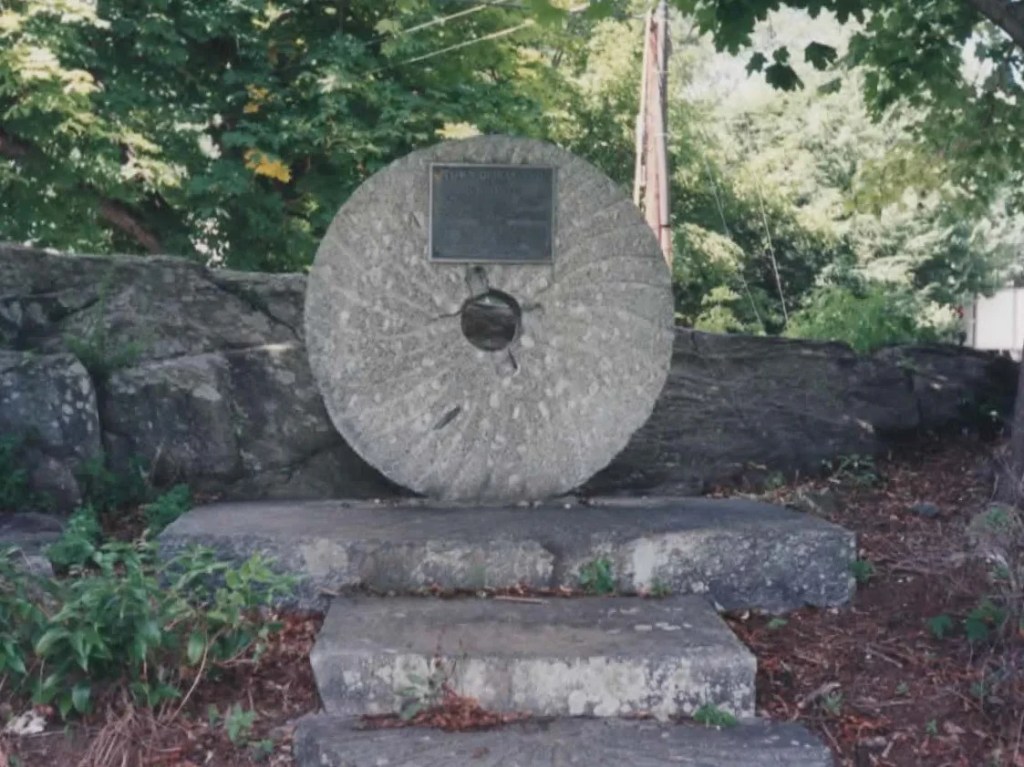
In the ten trips around the sun I spent at this address, trees matured, shrubs expanded, seasons spun, and I grew taller. One thing, however, did not change: the ancient millstone, lying flat and still beneath our front maple tree.
Its broad, etched surface served as home base for every single game of freeze tag and hide-and-seek. It was the waiting pad for our school bus each morning, and the circle where we played with our pet frogs before releasing them to the pond.
Atop this millstone, I bowed and accepted my Olympic gold medal after completing the perfect cartwheel, and it served as the table for tea parties with my first-grade friends; the place I sat, crisscrossed and scribbled secrets into my journal. Other days, I sprawled on my back, arms resting beneath my head atop the cool millstone, enjoying the drifting clouds while reading Nancy Drew, Charlotte’s Web, and Little Women, inhaling the fresh air, daydreaming the hours away.
What I did not know: that 800-pound millstone was an artifact: one of a pair used by our town’s first mill, built alongside our pond, and used to grind wheat into flour in the year of our Lord 1688, and for the 200 years to follow, until the fire.
A fire that destroyed everything, save the millstones.
My brother and I tried to lift the millstone a time or two, which of course proved fruitless. A stone of that weight is impossible to lift.
//
It was not until I was a young wife and mother that I opened my Bible and read Jesus’ words in Luke 17:1-2:
And he said to his disciples, “Temptations to sin are sure to come, but woe to the one through whom they come! 2 It would be better for him if a millstone were hung around his neck and he were cast into the sea than that he should cause one of these little ones to sin.
When I first read his words, my heart thumped. This was strong, terrifying language. My mind flew back to Old Mill Road and our millstone.
I clutched my throat, feeling the burden of the heavy millstone circling my neck as I was flung into the cold sea. Thinking of it now– I sense the terror as I thrash and drop to the ocean floor, legs kicking and arms flailing, gasping as I drown, wide-eyed, desperate, unable to escape death.
A horrifying way to perish.
Do you mean to tell me that this violent death is better than leading another Christian to stumble? To sin?
Yes.
Woe to me if I lead another believer to sin.
//
It is time, dear Christian, to wake up and pay attention to your life. Read your Bible and listen to the savage language that Jesus chooses as he speaks of eradicating sin. (Matthew 5:29, Matthew 5:30) Believe him. Take heed of the severity of leading others astray.
Temptations to sin are inevitable, but woe to those who cause another to stumble.
As God’s people, may we snatch others from the fire, rather than enticing and dragging people straight into it.
A few examples of normalizing sin: flimsy church attendance, gossiping, watching movies or shows that normalize sexual sin and coarse language, and reveling in a life of self-indulgence rather than denying ourselves and living to serve God and others.
Our spouses, children, grandchildren, friends, neighbors, and church family are watching us, learning from our lives. The consequences of our personal sins are always corporate, stretching like a translucent spider web across a barn door.
What brutal and alarming words from Jesus: death by drowning, weighted by a millstone, would be better.
I now understand that whatever sins I permit, embrace, and normalize will shape not only me, but others. What sins I relinquish, turn away from, and repent of will bless others.
It is not the absence of sin but the grieving over it which distinguishes the child of God from empty professors. – A.W. Pink
//
The next time you are tempted to sleep in and forsake the gathering, consider the precious faces of your spouse, your children, your grandchildren, and your church family. As you normalize forsaking the gathering, your choices will open the door for others to follow you into sin. It would be better for you to drown with a heavy millstone around your neck than treat church as a hit-or-miss affair and invite others to do likewise.
The next time you have a juicy tidbit to share, consider the person before you and understand that as you spread gossip, you are causing another to stumble. It would be better for you to drown with a heavy millstone around your neck than to gossip and invite others into such poison.
The next time you choose a movie or a show, consider what you are allowing not only into your living room, but into the hearts and minds of others. It would be better for you to drown with a heavy millstone around your neck than to corrupt a fellow Christian.
The next time you ignore the needs of others and choose to feast upon your precious bucket list, counting all of the ways and dollars you may entertain yourself before you die, consider that your children, grandchildren, friends, neighbors, and church are learning, from you, that old age equals a heaping dish of self rather than a happy denial of taking up your cross and following Jesus. It would be better for you to drown with a heavy millstone around your neck than to spend your winter season of life wasted, spoiling yourself, and inviting others to stumble.
When God speaks with clarity, which he always does through the Bible, listen to him, love him, fear him, obey him, and repent.
Woe to us if we tempt another to sin. Death by millstone would be better.
Here is a call for the endurance of the saints, those who keep the commandments of God and their faith.
Revelation 4:12
For biblical help in killing personal sin, I highly recommend: Transformed into His Likeness: a Handbook for Putting off Sin & Putting on Righteousness by Armond P. Tiffe

 The Palest Ink
Excellent reminder from Scripture of the poison and power of sin, thank you
LikeLiked by 1 person
🙏🏻
LikeLike
Thank you for the exceptionally beautiful imagery that prepares us for this sober warning from God’s own lips. I copied the link to your article into a note on the word millstone in Luke 17:2 so it’s handy for sharing and recalling from my e-Bible. 📖💖
LikeLiked by 1 person
🙏🏻Thank you, Allacin. 🙂
LikeLike